
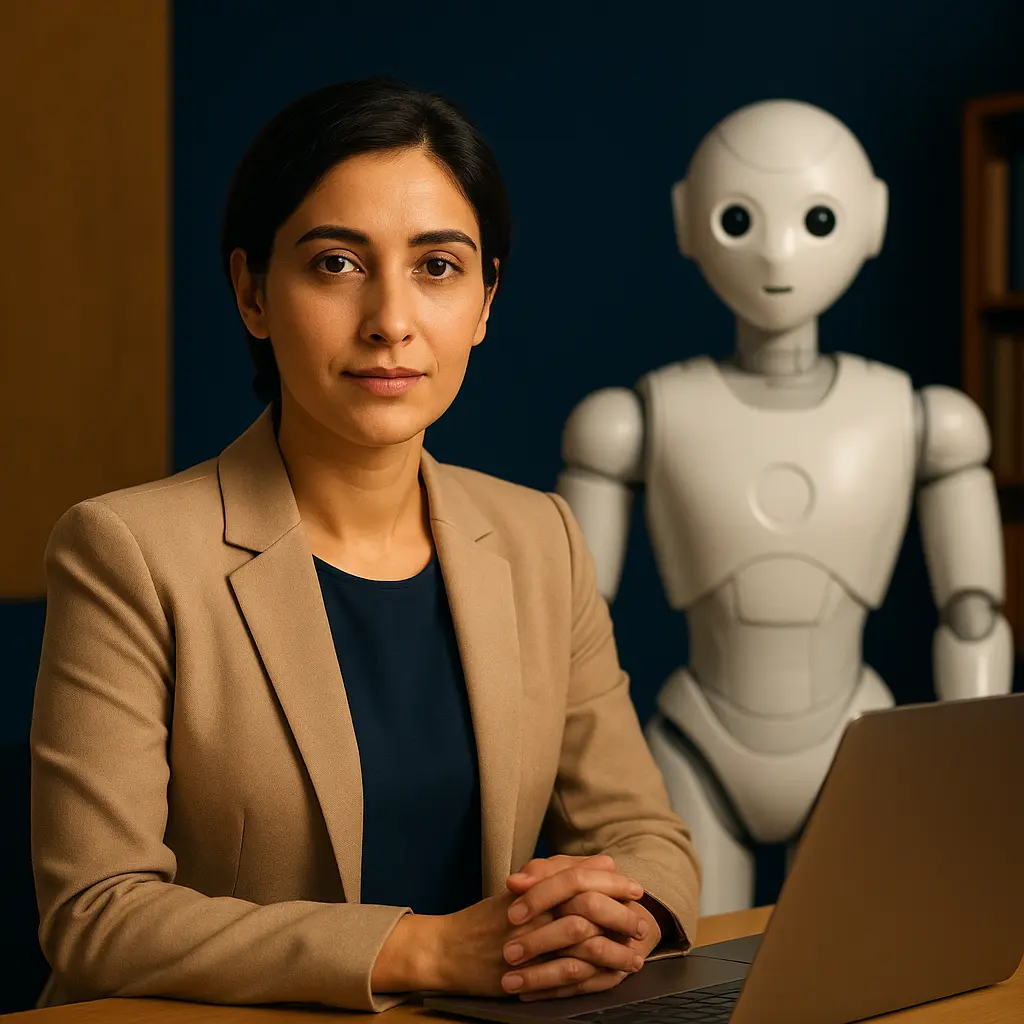
Artificial intelligence can support personal development as an educational and analytical companion. It can help you recognize behavioral patterns, set clearer goals, plan your learning, and choose exercises that fit your needs. Its real value appears when it strengthens self-knowledge and conscious action rather than making decisions on your behalf.
Personal development is not simply the collection of information or the receipt of general advice. It requires recognizing patterns, turning insight into behavior, and reviewing progress over time. Artificial intelligence can contribute to all three stages, but the outcome depends on the quality of your questions, your honesty in describing situations, and your consistency in practicing new behaviors.
What Role Does Artificial Intelligence Play in Personal Development?
By processing information and generating context-sensitive responses, artificial intelligence makes it possible to have a fast and structured conversation about goals, habits, learning, communication, and time management. It can break a broad issue into smaller steps, suggest exercises, provide feedback, and ask more focused questions when you review your growth path.
It is important to distinguish between information, insight, and behavioral change. Artificial intelligence can generate information and suggestions and help you develop insight. Sustainable change, however, occurs when you test that insight in real situations and repeat the desired behavior.
Supporting Self-Knowledge and Recognizing Behavioral Patterns
One of the most useful applications of artificial intelligence is helping you notice patterns that repeat in everyday life. For example, you can ask it to organize your reflections about conflict, decision-making, or time management and identify the themes that appear most often. This process should not become labeling or judgment about your personality. Its purpose is to identify a useful starting point for practice.
At the Academy, the artificial intelligence advisor is available to signed-in users. The advisor can access summaries of your unlocked tests and selected related articles from the knowledge base, then use them to create an educational conversation. If an analysis is locked, only its permitted teaser is included. The advisor's responses should therefore be understood within the limits of the available information and as educational interpretation.
Designing a Personalized Learning Path
Effective learning is more likely when it matches a person's actual needs and preferred way of engaging with a subject. Artificial intelligence can help turn a general goal such as “improve my communication skills” into a specific process: study one topic, observe your current behavior, complete an exercise, receive feedback, and review the result.
To receive more useful guidance, describe your goal in detail. Instead of asking, “How can I improve?” ask: “During work meetings, I remain silent when someone disagrees with me. What exercises could help me express my view respectfully over the next four weeks?” A precise question gives the system the context needed to produce a more practical response.
Turning Goals into Habits and Daily Actions
Many personal development plans fail because they remain too general. Artificial intelligence can help translate a goal into observable behavior. For instance, “manage my emotions better” might become pausing before responding, naming the emotion, and recording recurring triggers.
Plans should be short, measurable, and realistic. You can ask artificial intelligence to design a one-week program that takes less than fifteen minutes per day. At the end of the week, review which exercises you completed, which obstacles appeared, and what should change in the next cycle.
Artificial Intelligence, Self-Knowledge, and Educational Assessment
Assessment tools can provide a shared language for discussing behavior, emotions, and learning preferences. Their results should be used as a starting point for observation and practice, not as a final judgment about a person's identity.
Interpreting a Behavioral Pattern and Behavioral Code
In the DISC model, the focus is on understanding a behavioral pattern and a behavioral code: how a person tends to make decisions, communicate, and respond to pressure or change in different situations. Artificial intelligence can help translate these concepts into everyday situations, such as choosing a more effective way to communicate with colleagues whose patterns differ from your own.
Raw scores should not become the main message. What matters is the meaning of the pattern, the strengths that can be used effectively, and the path for growth. تست آکادمی با نسخه رسمی سازگار سازی شده The Academy's artificial intelligence advisor is also an educational assistant, not a licensed therapist or psychiatrist and not an official DISC certifying body.
Using Emotional Intelligence to Design Practice
The Academy's EQ assessment offers an educational view of five commonly discussed areas: self-awareness, self-regulation, motivation, empathy, and social skills. Artificial intelligence can use this profile to suggest exercises related to noticing emotions, pausing before reacting, listening empathetically, or following through on a goal.
A higher result does not mean that a person is “healthier,” and the profile is intended for educational self-knowledge and practice. This process does not replace treatment for emotional disorders. When significant distress or serious difficulties are present, consulting a qualified professional is important.
Understanding Learning Preferences and Interpersonal Skills
The additional assessment based on Gardner's multiple intelligences can be used to explore learning approaches, not to rank overall intelligence. The profile may help you experiment with visual, verbal, analytical, or hands-on ways of learning.
An interpersonal skills report also addresses relationship quality, boundaries, and cooperation. A single overall result should not be reduced to labels such as “social” or “unsocial.” Artificial intelligence can use the report to suggest exercises for expressing boundaries, making clear requests, giving feedback, and resolving disagreements.
How to Use Artificial Intelligence More Effectively for Personal Development
- Define the issue: Describe one real and observable situation instead of making a broad request.
- Provide context: Explain your goal, time limits, environment, and desired outcome.
- Turn the response into action: Ask for short, measurable exercises rather than abstract recommendations.
- Examine assumptions: Treat every analysis as a hypothesis and compare it with your own observations and experience.
- Request feedback: After practicing, record the result, obstacle, and emotional response, then ask for help planning the next step.
- Protect privacy: Avoid entering sensitive identifying information or unnecessary private details about other people into artificial intelligence tools.
Limitations of Artificial Intelligence in Personal Development
Artificial intelligence may produce answers that sound clear and convincing but do not fully fit your circumstances. Its analysis also depends on the information available to it. When the information is incomplete, unclear, or one-sided, the resulting guidance may be limited as well.
Artificial intelligence should not replace human relationships, ethical judgment, or qualified professional support. In situations involving emotional disorders, crisis, risk of harm to oneself or others, or serious relationship difficulties, a conversation with a tool is not sufficient. Appropriate professional support should be sought.
Personal development should also not turn into permanent dependence on ready-made answers. A constructive goal is for artificial intelligence to gradually strengthen your ability to ask better questions, observe more accurately, and make more independent decisions.
Frequently Asked Questions
Can artificial intelligence design my personal growth path completely?
It can suggest goals, plans, and exercises, but you remain responsible for choosing the goal, evaluating whether the suggestions fit, and putting them into practice.
Should behavioral test results be treated as a definitive personality diagnosis?
No. They are intended to help you understand patterns, recognize strengths, and design a growth path, not to label you or issue a final judgment.
What information can the Academy's artificial intelligence advisor access?
For a signed-in user, the advisor can access summaries of unlocked tests and selected related articles from the knowledge base. If an analysis is locked, only its permitted teaser is included.
What is the best way to begin using artificial intelligence for personal development?
Choose one small and specific challenge, define it as observable behavior, and track and review your practice for one week.
Next step: To explore self-knowledge further, visit the Academy's behavioral tests and test education resources. For related topics, browse the Academy's articles.